
Is your company directly or indirectly owned by a non‑U.S. person (individual or legal entity)? Does your U.S. company own a subsidiary or joint venture outside the United States? If so, regardless of when your company was formed or how long it has been operating, you may be subject to mandatory federal filing obligations to the U.S. Commerce Department’s Bureau of Economic Analysis (BEA). This Alert explains what they are, what happens if you miss them, and how to fix it.
The BEA requires companies with cross‑border ownership to file periodic surveys under the International Investment and Trade in Services Survey Act. These filings are: (i) confidential (the data “may be used only for analytical or statistical purposes” and “cannot be used for purposes of taxation, investigation, or regulation”[1]); (ii) mandatory (some must be filed even if the BEA has never contacted you); and (iii) separate from IRS international reporting, so forms 5471, 5472, or FBARs do not satisfy any BEA obligation. Anyone who should have filed and did not do so is already delinquent.
The Filing Map at a Glance.
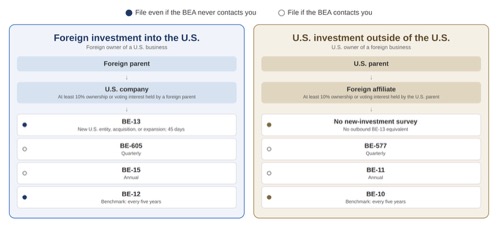
Filing requirements for inbound and outbound directions are independent and should be assessed separately. That is, a foreign‑owned U.S. company that itself owns a foreign subsidiary falls under both columns of the map above and may be required to file forms in each direction.
What Is at Risk. Civil penalties currently range from $5,911 to $59,114 per violation,[2] and each missed form may constitute a separate violation. Willful failure is criminal, carrying fines and up to one year of imprisonment. Officers, directors, employees, and agents who knowingly participate can be held personally liable.[3]

The Good News. Enforcement has historically been limited, though the BEA does send failure-to‑file notices. Delinquent filings can usually be cured simply by filing late, and the BEA routinely grants reasonable extensions. That is why it is better to check your exposure before the BEA makes contact.
Ownership Alone Can Trigger a Filing Obligation. A single 10% ownership or voting interest can require a filing regardless of dollar value, even for the smallest holding.
Surveys You Must File:
- Even If Never Contacted by the BEA. New inbound investment must be reported on the BE‑13 within 45 days after an acquisition closes, a new U.S. entity is established, or an expansion begins, regardless of size. Size determines only which form: transactions over $40 million (raised from $3 million in 2025) file the full form; smaller ones file a short Claim for Exemption. The expansion trigger is broader than it sounds: buying land for construction or signing a lease on a new facility can start the 45-day clock before ground is ever broken, and follow-up cost reports (Form BE-13E) may be required annually while the project remains under construction. The catch? Even dormant or money‑losing entities count; any business you own 10% or more of is reportable in a benchmark year regardless of profitability.
- Only When Contacted by the BEA. The recurring annual (BE‑15 inbound, BE‑11 outbound) and quarterly (BE‑605 inbound, BE‑577 outbound) surveys are required only if the BEA contacts you, and only for affiliates above certain size thresholds. Once contacted, you must respond every period, even if only to claim an exemption.
Private Funds. Investments held through certain fund structures may be exempt from these surveys or reportable using different forms, so fund sponsors and their portfolio companies should assess their obligations separately.
Real Estate Investments Are Also Reportable. U.S. real estate held for profit is itself treated as a U.S. business, so even a single rental or investment property owned by a foreign person can trigger a filing, often only a short exemption claim, since the benchmark and new-investment surveys have no size floor. A home held purely for personal use is not reportable. The reverse also holds: a U.S. person who owns a rental or investment property abroad generally holds a reportable foreign affiliate.
What You Can Do Now. Determine whether you must file, which forms apply, which deadlines have passed, and how to bring your company into compliance. For many companies, the answer is a single missed benchmark report, often on an abbreviated form, rather than years of quarterly filings, and the cleanup is usually narrower than feared.
This Alert is provided for general informational purposes only, does not constitute legal advice, and does not create an attorney‑client relationship. Filing obligations, thresholds, deadlines, and penalty amounts depend on specific facts, are current as of August 2026, and are subject to change. The BEA also conducts separate mandatory surveys covering cross‑border services and royalty transactions, which are beyond the scope of this Alert.
[1]International Investment and Trade in Services Survey Act, 22 U.S.C. §§ 3101–3108 (§ 3104, confidentiality); see U.S. Bureau of Economic Analysis survey confidentiality statement.
[2]Civil penalties of $5,911 to $59,114 per violation, adjusted for inflation effective January 15, 2025 (no 2026 adjustment). 15 C.F.R. § 6.3; 22 U.S.C. § 3105.
[3]22 U.S.C. § 3105(c) (willful violations; personal liability for officers, directors, employees, or agents who knowingly participate).